
Filed under Areas · 4 min read
Most people who move to the Richmond area bring a car, and many keep using it for everything. But the region’s transit system has one feature that changes the math: riding it costs nothing. If you are choosing where to live, it is worth knowing where the buses go before you sign a lease.
Who runs the buses
GRTC, the Greater Richmond Transit Company, runs public transit for the region. Its history goes back to 1860. The current agency was bought from private owners and incorporated on April 12, 1973, and it is jointly owned by the City of Richmond and Chesterfield County. It also serves surrounding counties and cities.
Zero fare, and what that means
GRTC says plainly that all buses are zero fare. There is no ticket, pass or card to buy, and you can enter at any open door. The same open-access policy covers the Pulse, local and express routes, the LINK microtransit vans and the airport service. Buses have onboard Wi-Fi, charging ports and real-time information screens.
The Pulse
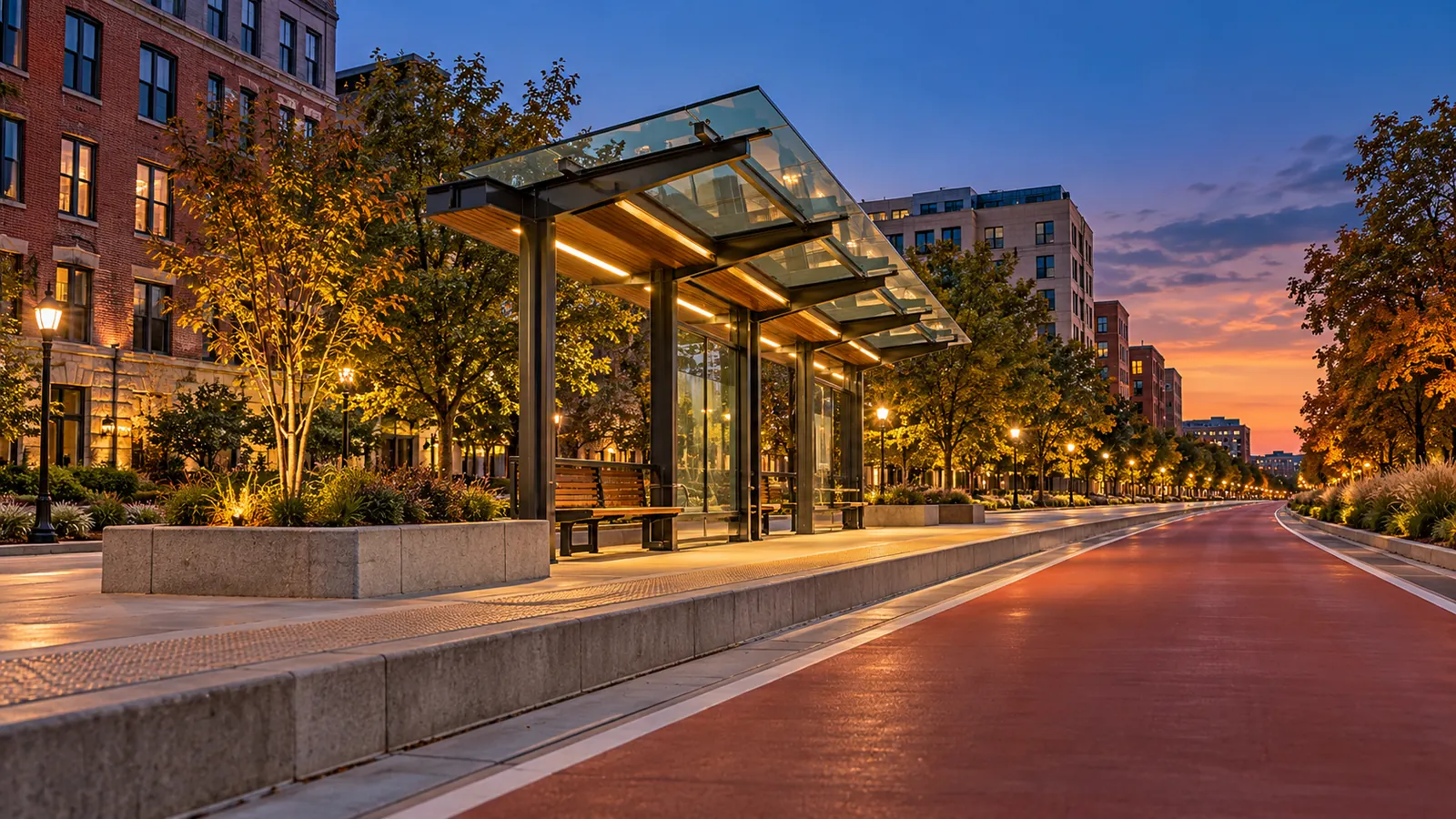
The Pulse is GRTC’s bus rapid transit line, running between Willow Lawn and Rocketts Landing. It runs every 10 minutes on weekdays at peak times and every 15 to 30 minutes at other times. It stops only at raised, platform-level stations and uses smart traffic signals to stay on schedule.
A few practical details help first-time riders:
- Stations on the southern side of the road serve eastbound buses; stations on the northern side serve westbound ones. Each station has a tall totem marked EASTBOUND or WESTBOUND.
- Some stations sit at the curb and some in the median. Median stations are reached by crossing at the signal and walking up a protected ramp. GRTC asks riders never to cross traffic lanes or climb railings to reach them.
- Arrive five minutes early. Overhead signs show minutes to the next bus, and a button plays an audio announcement.
Because demand on Broad Street has grown, GRTC is replacing standard buses on the Pulse with 60-foot articulated buses that hold up to 122 passengers and have three doors. They are being delivered in phases and are expected to be fully in service by the end of 2026. GRTC warns that frequency may shift temporarily during the changeover.
Local and express routes
Regular buses stop only at marked bus stops. GRTC asks riders to be at the stop five minutes early, wait on the sidewalk and let the bus stop completely before boarding. To get off, pull the yellow cord or press the stop button. Every bus has a front bike rack; the instructions are printed on the rack, and you should tell the operator when you are getting off so you can unload your bike.
LINK: on-demand vans
In some areas GRTC runs LINK, a curb-to-curb microtransit service. You book a ride in the GRTC On the Go app or by phone at (804) 358-4782 between any two points inside a LINK zone, and a van picks you up. It is also free. A few rules are stricter than on the bus:
| Rule | Detail |
|---|---|
| Group size | Up to 4 passengers per booking |
| Waiting | The driver waits 5 minutes after arriving, then marks a no-show |
| No-shows | Four no-shows in 30 days suspend service: 3 days the first time, then 7, 14 and 30 days |
| Children | Riders under 16 must be with an adult; bring your own car seat or booster |
| Seatbelts | Required by law |
| Booking time | Book at least an hour before the zone’s service ends |
Zones are expanding. On October 19, 2026, GRTC is enlarging the Azalea LINK zone to reach an estimated 2,100 more residents and 1,400 more jobs.
Getting to and from the airport
GRTC offers three free ways to reach Richmond International Airport. Routes 7A and 7B run between the airport and the Downtown Transfer Station, departing from the upper departures deck every 15 minutes. Inside GRTC’s Sandston zone, which includes the airport, you can book a LINK van. And for early flights, between 4 a.m. and 6 a.m. every day, riders can use a voucher for one Uber ride per day between a GRTC bus stop and the airport, in either direction.
Choosing where to live with transit in mind
The Pulse corridor along Broad Street is the backbone of the system and the subject of its own city plan, the Pulse Corridor Plan. Census data show the mean commute in Richmond city is 21.7 minutes, against 22.6 minutes in Henrico and 26.4 minutes in Chesterfield. If you want to live without a car or with one car instead of two, look for addresses within walking distance of a Pulse station or a frequent route, and check the GRTC system map before you sign. The trade-offs between the city and the counties are covered in Richmond City, Henrico or Chesterfield? How the Three Localities Compare for People Moving In.
Tip: If you keep a car, the state gives new residents 30 days to register it and 60 days to switch to a Virginia driver’s license. The steps are in New to Virginia: Driver’s License in 60 Days, Car Title and Registration in 30.